INSTITUTIONAL EYE Corporate Governance Scores 2026: Raising the Bar 10 Mar, 2026
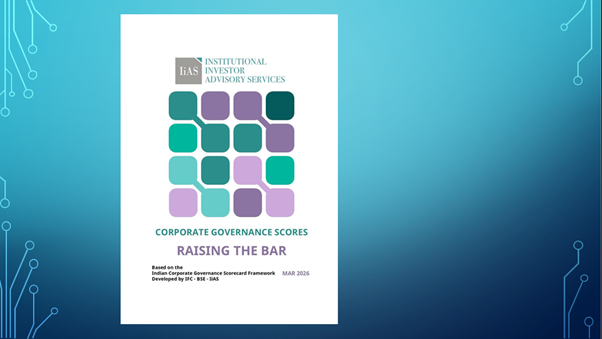
On 10 March 2026, Institutional Investor Advisory Services (IiAS) released the tenth edition of its annual survey on the corporate governance practices of BSE-100 companies. The report was released by Mr U.K. Sinha, former chairman of SEBI.
Titled ‘Raising the Bar’, the report carries our assessment of the BSE-100 index constituents is based on the Indian Corporate Governance Scorecard framework, that was jointly developed by IFC, BSE, and IiAS. IiAS scores these companies based on publicly available information that all investors can access. The scorecard and its scoring methodology are publicly available in our 2025 report. For a full understanding of the methodology and its limitations, we encourage you to read the 2025 report available on our website: IiAS Governance Scorecard. Based on the final score, companies are divided into four categories – Basic, Fair, Good and Leadership. There were 10 companies, with a score of over 75%, that were in the Leadership category in this assessment.
It is important to note that the Leadership is a score bucket that denotes governance practices that are superior to companies in the remaining categories: it is not an award. Like all evaluation frameworks, the Indian Corporate Governance Scorecard has always come with explicit caveats, and we have been transparent about them since inception. A high score is not an indicator of current or future financial performance, or stock price performance. The scores also do not indicate the permanency of governance practices: a company's practices may improve or deteriorate from the date of scoring.
This year’s assessment reflects a more mature governance landscape – one where the focus is no longer limited to formal compliance, but increasingly on how boards and management translate governance frameworks into effective oversight, resilience, and long-term value creation.
The 2025 findings point to a steady, broad-based improvement in governance standards across the BSE100. The median score has increased to 63 from 61 last year. Importantly, this improvement is not driven by a handful of outliers; rather, it reflects incremental strengthening of practices across a large part of the index constituents. The absence of companies in the Basic category for a second year suggests more consistent governance practices among India’s largest listed companies, and that well-governed companies eventually find their place in key indices.
This year’s assessment highlights the role of boards in shaping governance outcomes. Regulatory changes effective in 2024 have led to changes in board composition across the index, creating both opportunities and challenges for companies. While several boards have used this transition to strengthen overall composition in terms of diversity and skills, challenges remain - particularly around succession planning at the executive level, alignment of executive remuneration, special rights to shareholders, and the effective functioning of board committees. Investor scrutiny in these areas has increased, reinforcing expectations that boards provide effective oversight in the interests of long-term shareholders and other stakeholders.
Sustainability and resilience have become more central to a company’s governance framework. Companies increasingly recognise climate risks, supply-chain issues, workforce well-being, and ethical conduct as relevant to business performance. Although BRSR and BRSR Core have improved the availability of ESG-related information, the quality of disclosures remains patchy; and even as many companies have set net-zero targets and outlined transition plans, progress on implementation and outcome measurement continues to vary.
At the same time, shareholder engagement has become more structured and consequential. Institutional investors are increasingly assertive on issues such as employee stock option schemes, related party transactions, special rights to a set of investors, executive pay, and disclosure quality. Although promoter ownership continues to shape voting outcomes in India, companies are showing greater sensitivity to investor feedback - often engaging earlier and more substantively to address concerns before they escalate into dissent.
The Indian Corporate Governance Scorecard remains anchored to the G20/OECD Principles of Corporate Governance, incorporating the Sustainability and Resilience principle introduced in the 2023 revision. With equal weight assigned to all four assessment categories - shareholder rights, sustainability and resilience, disclosures and transparency, and board responsibilities - the scoring framework reflects a more balanced view of governance. Companies that have invested consistently in stronger boards, clearer disclosures, and responsible stakeholder practices continue to feature among the leaders, meeting the increased expectations. The current scorecard is a derivative jointly by International Finance Corporation (IFC), a member of the World Bank Group and Bombay Stock Exchange (BSE) and IiAS. The scorecard is based on the widely accepted G20/OECD principles of Corporate Governance Taken together, this year’s assessment points to greater emphasis on implementation alongside policy adoption. The challenge ahead lies not in articulating intent, but in demonstrating consistency, accountability, and outcomes.
Our 2025 report can be accessed through the link here.
IiAS is a SEBI registered entity [Proxy advisor registration number: INH000000024]